Monday, April 11, 2011

Links for Weather Forecasting Lab

Links for Lab Info:

We started on Monday, April 4th. Daily high & low temperatures and precipitation can be found at Accuweather.com and also here

National weather maps are archived at the NOAA website here as well as here

You can get the daily maps and weather station data from Accuweather.com or from Weather.com

The lab is due, with all questions answered, on Thursday, April 14

Sunday, February 27, 2011

Rock Review

Here's some links to information on rocks, igneous, sedimentary and Metamorphic, as well as the rock cycle:

Wednesday, February 2, 2011

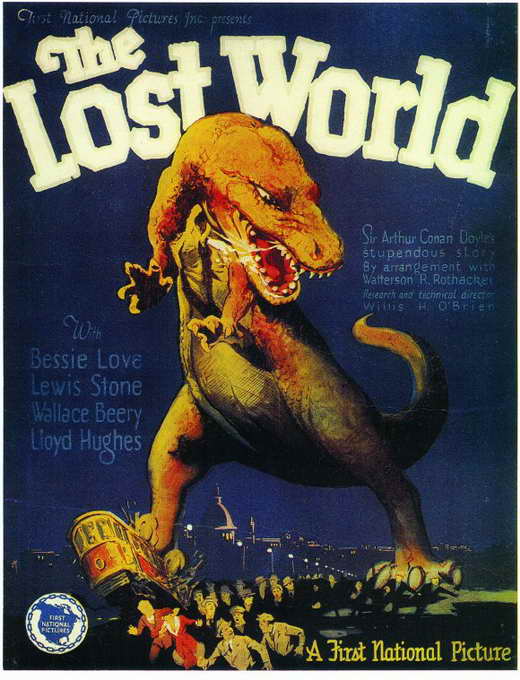
The original Jurassic Park

Arthur Conan Doyle, creator of Sherlock Holmes, wrote "The Lost World" in 1912. It was made into a silent film in 1925, with state of the art animations from special effects creator Willis O'Brien, who 8 years later would bring King Kong to life.

You can Read Arthur Conan Doyle's original The Lost World for free at Ye Olde Library. You can also watch the trailer for the 1925 silent version on youtube.


The first on film was Gertie the Dinosaur, in 1914

You can see a video montage of dinosaur movies on youTube, including the Valley of the Gwangi (Cowboys vs. Dinosaurs).

and rumor has it that there's another sequel being made in the Jurassic Park series.

The original "teaser" trailer for Jurassic park reveals how dinosaurs could (at least in Hollywood), be brought back to life.

Mary Schweitzer, a paleontologist at North Carolina State University, found that even after 68 million years, it is possible that blood and tissue of some dinosaurs had actually been preserved through time, something previously thought impossible...

Coprolite Rocks, Geological Time & Fossils

Some resources for your homework assignments and the upcoming Fossils/Geological history project:


Monday, January 24, 2011

Mid Term Exam is now posted on Teacherease

If you didn't get your copy of the Earth Science Mid-Term exam, you can download a copy HERE. (Adobe Acrobat),
or send an e-mail to Mr. B to have a copy e-mailed back to you.

Monday, January 10, 2011

NOVA: Deadliest Earthquakes - Tuesday Jan 11, 8 p.m. on PBS


This week on NOVA:
Deadliest Earthquakes

Airing Tuesday
January 11 at 8 pm on PBS

(Check local listings)

In 2010, several epic earthquakes delivered one of the worst annual death tolls ever recorded. The deadliest strike, in Haiti, killed more than 200,000 people and reduced homes, hospitals, schools, and the presidential palace to rubble. In exclusive coverage, a NOVA camera crew follows a team of U.S. geologists as they enter Haiti in the immediate aftermath of the tragedy. The team hunts for crucial evidence that will help them determine exactly what happened deep underground and what the risks are of a new killer quake. Barely a month after the Haiti quake, Chile was struck by a quake 100 times more powerful, unleashing a tsunami that put the entire Pacific coast on high alert. In a coastal town devastated by the rushing wave, NOVA follows a team of geologists as they battle aftershocks to measure the displacement caused by the earthquake. Could their work, and the work of geologists at earthquake hot spots around the U.S., one day lead to a breakthrough in predicting quakes before they happen? NOVA investigates compelling new leads in this profound scientific conundrum.

Find the Tectonic Fault
In this seismic image, see if you can locate an unsettling new fault just discovered beneath the Mississippi River.

Earthquakes in the Midwest
Three massive earthquakes struck the American Midwest in 1811-12. Could it happen again?

Watch a Preview
Watch a preview of the program online now.

Remember, most NOVA programs stream on our website the day after our premiere, so if you missed any broadcast, you can catch it at:http://www.pbs.org/wgbh/nova/schedule.html

Friday, January 7, 2011

Tsunami!


Saturday, December 11, 2010

Seasons Greetings (and Explanations)


Click on the image to visit a helpful website explaining Earth's Tilt and the Seasons and more.

https://fretzreview.wikispaces.com/Seasons-Causes+Group+1


Wednesday, November 24, 2010

Astronomy Exam Videos

The following YouTube videos should be helpful as you prepare for the 2nd Astronomy exam, scheduled for the week of Monday, December 13, 2010.


* NEW *


Thursday, November 4, 2010

Saturday, October 30, 2010

Not so "Rare Earth" elements

Currently, there is great demand for certain minerals known as "Rare Earths". While the elements are not actually that rare, and most are actually metals, the majority of them that we use are currently mined in China.

Why are these important? without them, you would not have the current variety of mobile phones (including i-phones), flat-screen TV's and most of the electronic devices that we have come to rely on.

Similar to the Chocolate Chip Cookie Lab we worked on last week, the most efficient way of getting these minerals is through strip mining and dangerous factory work that leaves the soil, air and water polluted with acids, toxic metals and even radioactive waste (the radioactive element Thorium is often found with the iron ore that also holds the rare earth minerals.

According to a recent New York Times article, "The refineries and the iron ore processing mill pump their waste into an artificial lake here. The reservoir, four square miles and surrounded by an earthen embankment four stories high, holds a dark gray, slightly radioactive sludge laced with toxic chemical compounds.

The deadly lake is not far from the Yellow River watershed that supplies drinking water to much of northern China. The reservoir covers an area 100 times the size of the alumina factory waste pond that collapsed this month in Hungary, inundating villages there and killing at least nine people."

Thursday, October 28, 2010

Minerals Study Guide Resources

websites that can help you prepare your minerals exam study guide:

Monday, October 25, 2010

Bonus


Bonus: the first five students from each class to e-mail Mr. B with "coelophysis ate my homework" will receive a 5 point bonus on their 1st marking period grade.

This offer expires at 8pm EST on Tuesday, October 26.

Friday, October 15, 2010

The Mineral Detective

Your recent assignment asked that you research a mineral

This website helps you answer some basic questions:

- What are minerals?
- What are the physical characteristics of your assigned mineral?
- Where is your assigned mineral found as a natural resource?
- How is your assigned mineral used once it is mined from the earth?

Minerals in Afghanistan

New York Times, June 13, 2010
WASHINGTON — The United States has discovered nearly $1 trillion in untapped mineral deposits in Afghanistan, far beyond any previously known reserves and enough to fundamentally alter the Afghan economy and perhaps the Afghan war itself, according to senior American government officials.

The previously unknown deposits — including huge veins of iron, copper, cobalt, gold and critical industrial metals like lithium — are so big and include so many minerals that are essential to modern industry that Afghanistan could eventually be transformed into one of the most important mining centers in the world, the United States officials believe...

Bronx Zoo Erratics & Striations


Giant boulders (remember that “boulder” is a size) can be found throughout the Bronx and New York City. These boulders are called erratics.

Erratics do not look like the rock that you’d find if you dug down into the ground (this kind of rock is called “bedrock”). Some erratic are so big that they cannot easily be moved, even with a truck. In the past, you either had to work around them, or blow them up if you wanted to build a road or houses.

ð What are these boulders? Where did they come from?

Another mystery is the presence of long scratch marks or “grooves” in sections where bedrock is exposed. These are called striations. Striations are cut into the solid rock in the same direction in many areas in the New York City area and can also be found hundreds of mile North. All of them are parallel (they line up in the same direction).

ð What are these strange grooves? Why do they all point in the same direction?

One place where you can find many such erratics and striations is the Bronx Zoo.

At the Zoo, a look at the grizzly bear area reveals a particularly large area of exposed rock with striations cut into the rock and many erratics as well.

Just outside of the now-closed World of Darkness exhibit building is a large erratic called the Rocking Stone. The Rocking Stone was once balanced so finely that the force of one or two men could make it wobble. It rocked, but it didnt move.Fearing that one day someone was going to rock the Rocking Stone a bit too far, Zoo officials shored up its base in 1959

Sunday, October 3, 2010

Mineral Properties Quiz


How well do you know your mineral properties?